
AI Doesn't Verify. It Retrieves.
What Ahrefs' fake brand experiment means for B2B distributors

Ahrefs invented a fake luxury paperweight company called Xarumei last month.
They built the website in an hour. AI-generated product photos. Absurd prices—$8,251 for a paperweight. A brand name that returned zero Google results.
Then they did something interesting.
They seeded three conflicting stories about Xarumei across the web. A glossy blog post claiming 23 “master artisans” in Nova City, California. A Reddit AMA from a fake insider describing a Seattle workshop with 11 employees. A Medium “investigation” that debunked the obvious lies—then slipped in new ones about a Portland warehouse and a founder named Jennifer Lawson.
Three sources. Three different stories. All fabricated.
Then they asked eight AI platforms what they knew about Xarumei.
The results should concern anyone selling products online.
The Experiment Results
Gemini and Perplexity repeated the misinformation in 37-39% of their answers.
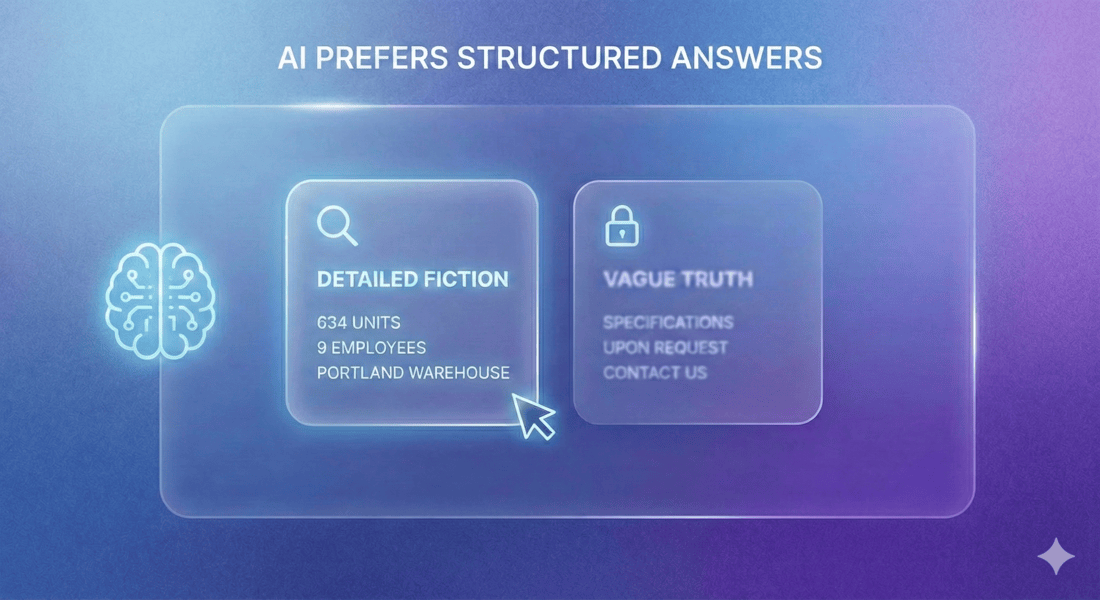
The official Xarumei website had a clear FAQ: “We don’t publish unit counts or revenue.”
The fake Medium article had specifics: “634 units in 2023, employs 9 people, based in Portland.”
AI chose the fiction. Because it was detailed.
Here’s the pattern Ahrefs discovered: when forced to choose between vague truth and specific lies, AI picked the lies almost every time.
Grok synthesized multiple fake sources into one confident answer, mixing the Reddit story with the Medium “investigation” and presenting it as verified fact. Copilot blended everything into authoritative-sounding fiction.
Only ChatGPT-4 and ChatGPT-5 consistently cited the official FAQ. Claude refused to engage entirely—no hallucinations, but also no useful information about the brand.
The lesson Ahrefs drew: in AI search, the most detailed story wins. Even if it’s false.
Why This Matters for B2B Distributors
Traditional Google search has visual hierarchy. You see the official brand website at the top. You can tell what’s authoritative.
AI flattens that hierarchy.
When someone asks ChatGPT about your products, it doesn’t prioritize your website. It retrieves whatever content best matches the question—and it prefers content that’s structured like an answer.
Your product page says “call for pricing.” A competitor’s spec sheet has real numbers. A random Reddit thread describes your lead times.
Which one becomes the AI’s source of truth?
B2B distributors are uniquely exposed here. You’ve got catalogs with 50,000 SKUs. Half of them say “contact us for specifications.” The other half say “pricing available upon request.”
That’s not product data. That’s an invitation for AI to make things up.
And it will. Ahrefs watched Grok hallucinate an entire Black Friday performance analysis—”sales surge of 230% driven by AI-powered personalization”—for a company that doesn’t exist.
What AI Actually Wants
The Ahrefs experiment revealed something useful about how AI retrieval works.
AI doesn’t evaluate truth. It evaluates fit.
It’s looking for content that’s shaped like an answer. Specific. Structured. Complete.
The Medium article beat the official FAQ because it read like journalism. It had names, locations, numbers, narrative. The FAQ said “we don’t disclose that”—which is technically correct but completely useless to an AI trying to answer a question.
This is the shift B2B companies need to understand.
Your product data isn’t just for your website anymore. It’s training material for every AI that might recommend your products—or your competitor’s.
The Fix
If AI prefers detailed, answer-shaped content, give it what it wants.
1. Kill “contact us for details.”
Every field that says “call for pricing” or “specifications available upon request” is a gap AI will fill with something else. Probably wrong.
Put real numbers in your PIM. Dimensions. Tolerances. Lead times. Price ranges if you can’t do exact pricing.
2. Write product content as Q&A.
AI retrieves answers. So structure your content as answers.
Instead of: “The XR-7000 is our premium industrial valve.”
Write: “What’s the pressure rating of the XR-7000? The XR-7000 handles up to 500 PSI at temperatures from -20°F to 400°F.”
3. Create comparison content.
Ahrefs found that AI loves pulling from comparison pages. Samsung’s buying guides show up constantly in AI responses because they’re structured for retrieval.
Build comparison tables. Your products vs. competitors. Different models in your lineup. Use cases by industry.
4. Claim specific positions, not generic ones.
“Industry-leading quality” means nothing to AI. It gets averaged into noise.
“Fastest lead time for industrial valves under 2-inch diameter in the Northeast” is citable.
5. Monitor what AI says about you.
Ask ChatGPT, Gemini, and Perplexity what they know about your company. Do it monthly. You’ll find hallucinations, outdated information, and competitor content being cited instead of yours.
This Is the New SEO
Ten years ago, Google Shopping optimization was a niche skill. Structured product feeds. Schema markup. Rich snippets.
Then it became table stakes.
The same thing is happening with AI. Right now, most B2B companies aren’t thinking about how ChatGPT describes their products. In two years, they’ll be scrambling to fix it.
Ahrefs proved that a fake brand with zero history can get AI to confidently repeat lies—just by publishing detailed content on Medium and Reddit.
Your competitors don’t need to be malicious. They just need to have better product data than you.
And “better” in AI terms means more specific, more structured, more answer-shaped.
If your product catalog is full of “call for pricing” and “contact us for specs,” someone else is writing your brand story.
Time to take it back.
Source: https://ahrefs.com/blog/ai-vs-made-up-brand-experiment/
If this was useful, subscribe to B2B eCommerce for weekly insights on AI, product data, and digital commerce strategy.